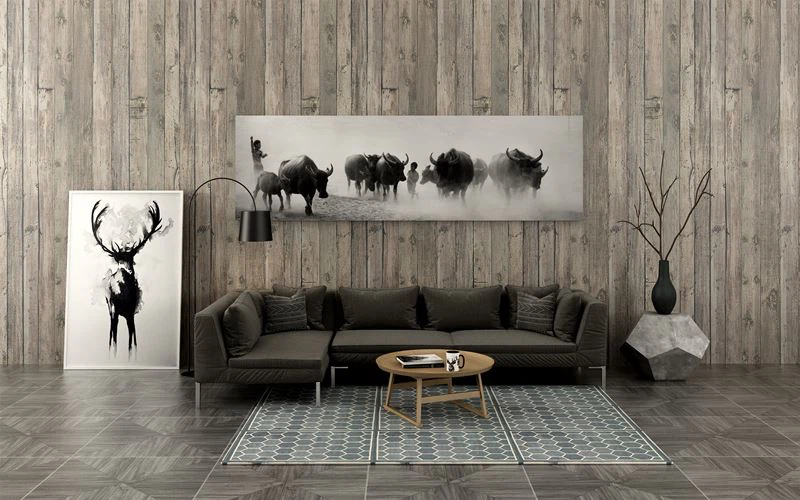










1. Single-frame suspension
The hanging method of a single decorative painting is the most common situation. For example, hang a decorative painting on the wall of the living room, entrance hall, etc. Because the entire wall is the background display, a single decorative painting usually becomes the center of vision. Unless it is a decorative painting covering the entire wall, it is recommended to pay attention to the ratio of the screen size to the wall size. The so-called proper proportion, a simple judgment is to pay attention to the left, right, up, and down margins, and there must be room for "breathing", rather more than less. The height of the painting should be based on the site farthest from the screen or the wall, or a site with an appropriate distance, with the individual's eye level as the centerline, and the decorative screen should be divided into equal upper and lower (1:1 ) Height or a slightly higher position with more up and down (2:1).
2. Single frame placement
Another way to display a single decorative painting is to use "placement". Compared with hanging, placing the decorative painting directly on a flat surface (such as the ground, floor, bookshelf, low cabinet) without hooks, and relying on the decorative painting on the wall. Since it is placed on a fixed plane, in the choice of height, you still have to consider the height of the eye level, and avoid placing the decorative paintings under the eye level, especially the decorative paintings placed on the floor. Decorative paintings should rely on the angle of the wall as close to the wall as possible and not lean forward as the principle.
3. Multiple suspension
Similar to a single-frame suspension, the overall picture effect should be considered when using multiple decorative paintings (more than two). In the case of multiple decorative paintings, whether they are horizontally expanded or hung vertically, the height and the ratio of the screen size to the wall size should be the same as a single decorative painting. The only difference is the distance between the multiple paintings. Basically, to maintain a proper breathing space between the various decorative paintings, first, consider the ratio of the overall picture to the wall, and then consider the size ratio between the single decorative paintings. There is no standard, but there are different aesthetics and styles. If multiple decorative paintings of different sizes are hung, it is better to divide the picture with eye level as the center. It is also necessary to have a height or a bottom, and the effect is different.
4. Multiple layouts
Similar to a single-frame display, when multiple decorative paintings (more than two) are used together, because they are placed on a flat surface (such as the ground, floor, bookshelf, low cabinet), basically only the spacing between the decorative paintings is considered. Usually, multiple layouts are spread out horizontally, at the bottom, at the same height, or not at the same height. But unlike many decorative paintings, there are more changes, such as quantity, size, height, etc. When placing multiple frames, the number should not be too large, and the size and size should not be too different, otherwise, it will lose the visual focus and become messy and scattered.